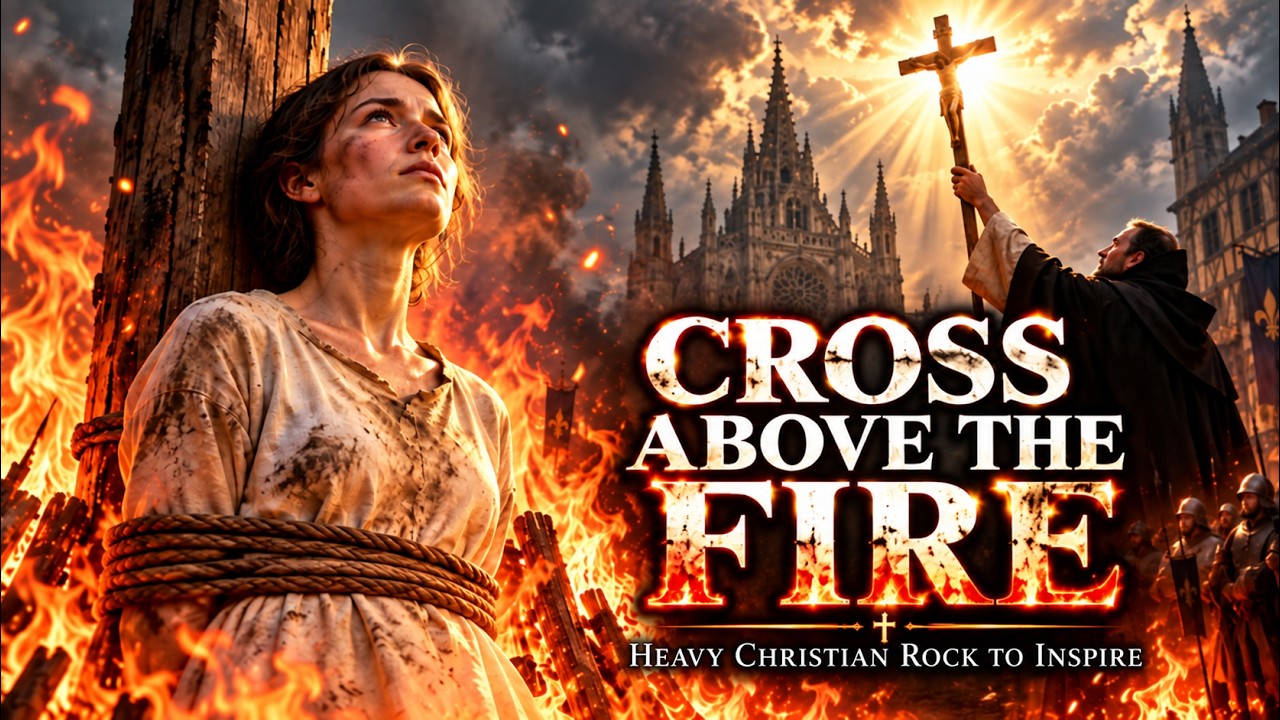
“Hold high the cross, so that I may see it through the flames!”
— attributed to Joan of Arc at the stake, Rouen, 1431
On May 30, 1431, in the old market square of Rouen, France, a 19-year-old peasant girl named Joan of Arc was tied to a stake and burned as a heretic. Years later, a Dominican friar named Isambart de la Pierre, who stood near her that morning, testified under oath about what she asked for. She didn’t ask to be rescued. She asked for a cross. She begged him to bring one from the church nearby and hold it up before her eyes until the end. He did. And as the flames rose, he said, she never stopped calling on the name of Jesus.
That moment is where our song Cross Above the Fire came from.
But this song isn’t really about Joan’s fire. It’s about ours. Most of us will never face a stake. Our fire is the struggle of just living: the pain, the loss, the fear, the exhaustion, the pride, and the moments when loving Christ actually costs us something. When the heat rises, every one of us looks somewhere. If we’re honest, there are really only two places to look.
We either look at the cross, or we look in the mirror.
The mirror is us. Our comfort. Our image. Our highlight reel. The cross is Jesus, and the kind of love that gives itself away. Joan, at nineteen, with the fire climbing, chose the cross. The question the song keeps asking is whether we will.
Why It Sounds Like a Battle
If you’ve listened, you know this isn’t a soft song. That’s on purpose. Joan was a warrior, and the choice between the cross and the mirror is a fight we face every day. So the music carries a warrior mentality: a heavy, driving riff, huge drums, guitars wide open. We enjoy harder rock, but the style always has to fit the idea, so across our songs you’ll also hear pop, blues, country rock and roots rock.
The subjects are personal, too. Much of what we write is autobiographical, drawn from what I’m living through right now, along the same lines as my books and these Reflections. The questions in this song are aimed at me first.
Cross or Mirror
The song opens with the whole question in two lines:
Will I die to live, or live for show?
Cross or mirror—which way will I go?
“Die to live” is the heart of something I wrote about in The Pain Paradox: “The crucifying part is the paradox. We must die to ourselves so that we may truly live.” Jesus said it first:
If any of you wants to be my follower, you must give up your own way, take up your cross, and follow me. If you try to hang on to your life, you will lose it. But if you give up your life for my sake, you will save it. (Matthew 16:24-25 NLT)
He doesn’t say admire the cross, or wear it. He says take it up. That is the exact opposite of the mirror.
The mirror is a glance. We see ourselves, we walk away, and nothing changes. Living for the mirror means living for how we look, to other people and to ourselves. In Brave the Wave I called the alternative living for an audience of one: “The question is: ‘What does Jesus think about what I’m trying to do?’” That is a hard question when the fire is hot. It is also the only one that matters.
The Fire Reveals the Love
The chorus is a prayer:
When loving You cost me something
Let me call out Your name
Chapter 8 of The Pain Paradox, “Pain and Love,” is built on one idea: “love is proven and purified through suffering.” Without that, love “eventually reveals itself as hollow.” A love that never costs anything isn’t much of a love. As I put it in that chapter, “Love’s authenticity is revealed and solidified when it moves from proclamation to proof.”
Joan’s words open chapter 17, “The Promise of Pain,” for a reason. The Bible doesn’t promise believers a life without fire. And as that chapter says, simply: “Pain reveals the truth.”
The fire doesn’t decide whether we love Jesus. It reveals whether we do.
Where We Live It
Your fire probably doesn’t look like Rouen. It might look like a diagnosis. A marriage under strain. A grief that won’t lift. Or just the daily grind of getting up and doing it again.
Mine often looks ordinary. When I get tired at work after seeing a lot of patients, sometimes I just want to go home and take it easy. That’s the mirror talking: my comfort, my day, my needs. But I begin to realize I’m not there for me. I’m there to help people get better and feel better. It’s not about me.
That is the hardest thing about putting the cross first. You have to be self-forgetful in order to have self-discovery and true authenticity. That’s the paradox. The mirror promises we’ll find ourselves by looking at ourselves, and we never do. The cross asks us to die to ourselves, and that is where we truly live.
We do this by keeping our eyes on Jesus, the champion who initiates and perfects our faith. Because of the joy awaiting him, he endured the cross, disregarding its shame. (Hebrews 12:2 NLT)
Notice where the eyes go. Not on the fire. Not on ourselves. On Jesus. That is exactly what Joan asked for. She couldn’t put the fire out, so she asked for something to look at above it.
So I keep asking myself, and maybe you can ask it too: in the place where I’m most tired right now, whose comfort am I really protecting? And who is the person in front of me that the cross is asking me to see?
Go deeper · Book 4 of The Authentic Self Series
The Pain Paradox
Chapter 8, “Pain and Love,” explores why love is proven through sacrifice, and Chapter 17, “The Promise of Pain,” opens with Joan of Arc at the stake. If this song hit home, those two chapters go deeper.
So when the heat rises in your life this week, what will you be looking at? The cross, or the mirror?
Keep reading: Seek To Be Admired? Or To Inspire. · 1% Of The Population Experiences “Profound” Love
Listen: Apple Music · YouTube · All songs & videos
More on these topics
